



Colorectal Cancer Biomarkers

Diagnostic tests & scans
Colorectal Cancer Biomarkers
Not all colorectal cancers are the same. Biomarker testing tells you and your doctor what is actually inside your tumor — and which treatments are most likely to work for you.
Real people, real reports
The Stories Behind Biomarkers

Colorectal Cancer Biomarker Testing: Ask Before Treatment Starts
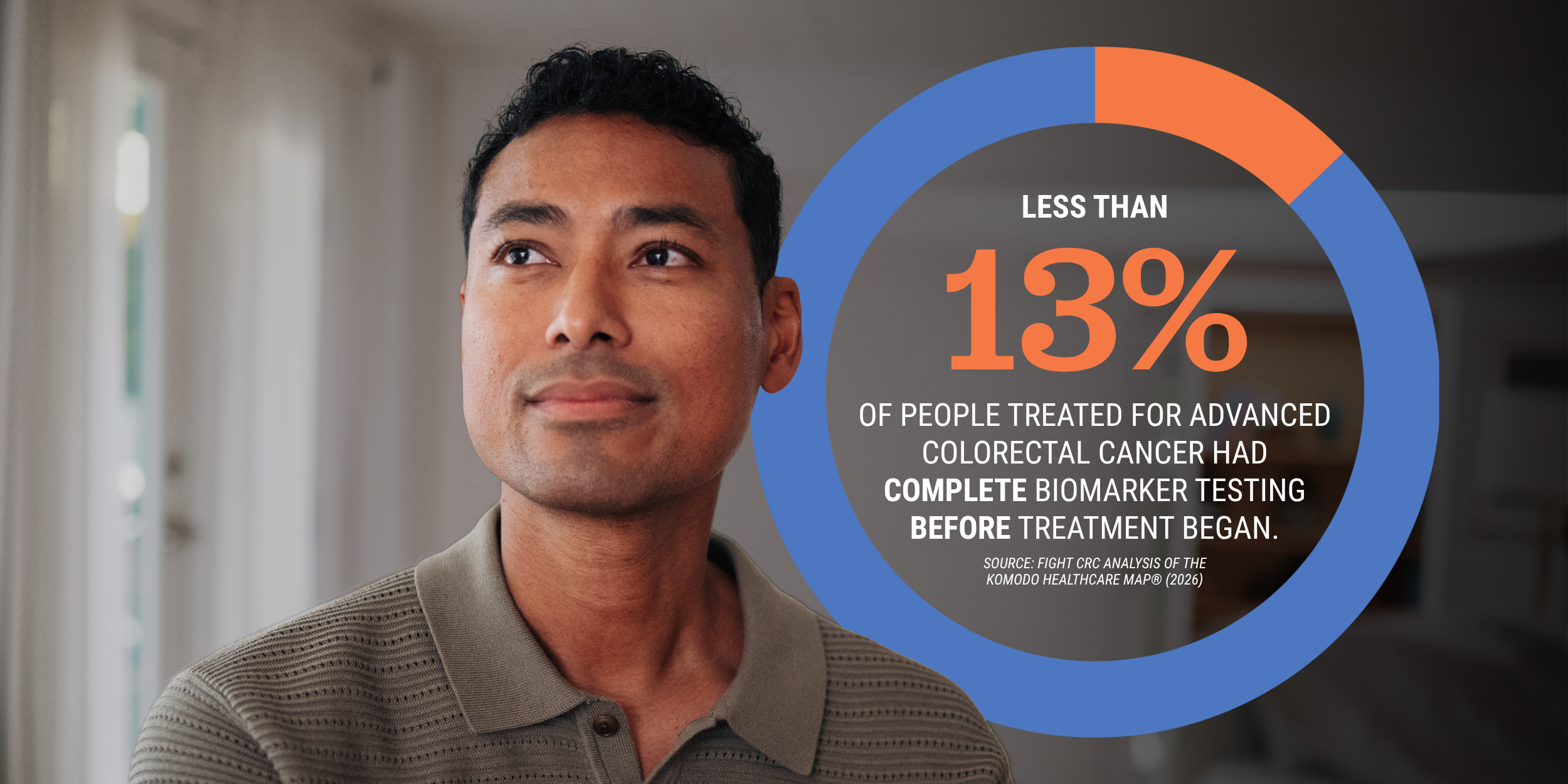
Ron, Lyle and Sydney were each diagnosed with colorectal cancer. Their stories show why one question matters before treatment begins: has my tumor been tested for biomarkers? A new analysis of de-identified, real-world data from Komodo Health’s Healthcare Map® finds that only about 1 in 8 treated patients ages 18 to 64 had complete testing before treatment. Source: Komodo Health. Komodo Healthcare Map: de-identified, real-world patient data representing more than 330 million de-identified U.S. patients. Data accessed October 2026. *Campaign Supported by: AMGEN

What are biomarkers, and how can they help?
Doctors and scientists from around the world spend two days deciding what to study next about colorectal cancer in people under 50 — in the same building as our advocates, so what they learn goes straight to Congress.







Start Here
What is biomarker testing?
Biomarker testing may be referred to as tumor, molecular, mutation, somatic, or genomic testing. The actual test is most often performed on a small amount of tissue obtained from a tumor during a biopsy or surgery. If that’s not possible to collect, a blood sample may also be used.
The tissue or blood sample is sent to a specialized lab for testing and analysis. The lab will provide a report to your doctor based on its findings. Once your doctor receives your report, they should discuss it with you and explain how each finding can impact your treatment plan.
Not all colorectal cancers are the same. Your biomarker testing report will be specialized to you and your tumor, which should lead to personalized treatment planning.
According to the NCCN Guidelines for Patients, “Biomarkers are specific features of cancer cells. Biomarkers can include proteins made in response to the cancer and changes (mutations) in the DNA of the cancer cells.”
A broad definition often comes with biomarkers, but it’s anything that can be used as an indicator of a disease.
Inside cancer tumors lie a variety of different markers, and tumor testing helps you and your doctor learn what’s inside your tumor and how to approach your treatment plan. Biomarkers allow your doctors to measure what’s objective and true about your cancer.
Your colon or rectal tumor might not respond to the same treatment that other colorectal cancer patients receive, depending on the biomarkers in your tumor.

Who Needs Testing?
| Stage 0 & Stage I | Your tumor needs to be tested for MSI-H/dMMR. You need your CEA checked. If your stage I cancer recurs, you need to be tested for biomarkers for metastatic disease. |
| Stage II | Your tumor needs to be tested for MSI-H/dMMR. You need your CEA checked. Ask your doctor if there is a role for ctDNA testing. If your stage II cancer recurs, you need to be tested for biomarkers for metastatic disease. |
| Stage III | Your tumor needs to be tested for MSI-H/dMMR. You need your CEA checked. Ask your doctor if there is a role for ctDNA testing. If your stage III cancer recurs, you need to be tested for biomarkers for metastatic disease. |
| Stage IV / Metastatic Disease | Your tumor needs to be tested for MSI-H/dMMR. You need to know which side your tumor formed (Right or Left). You need your CEA checked. Ask your doctor if there is a role for ctDNA testing. Your tumor needs to be tested for genetic alterations, including KRAS, NRAS, and BRAF mutations, HER2 amplification, and NTRK fusions. |
Biomarker testing for metastatic colorectal cancer
Metastatic colorectal cancer is cancer that has spread beyond its original location in the colon or rectum and formed one or more tumors in other areas of the body, like the liver and/or lungs. Treatment possibilities for patients have been greatly extended due to biomarker testing, and especially for metastatic colorectal cancer patients.
If you’re a metastatic patient, it’s critical that you undergo biomarker testing, ideally before starting treatment, so you can know if you are likely to respond to available targeted therapies.
Pre-surgery biomarker tip! Before surgery, ask your doctor about biomarker testing and confirm your tumor tissue will be analyzed and a biomarker report will be provided to you.

By the Numbers
Real-world data · Fight CRC analysis, powered by Komodo Health®
For the biomarker campaign data release, Fight Colorectal Cancer analyzed de-identified, real-world claims data from the Komodo Healthcare Map® — covering more than 50,700 patients with advanced colorectal cancer, ages 18 to 64, diagnosed between 2021 and 2026. This is what the data says about testing in practice.
TESTING IS NOT ROUTINE
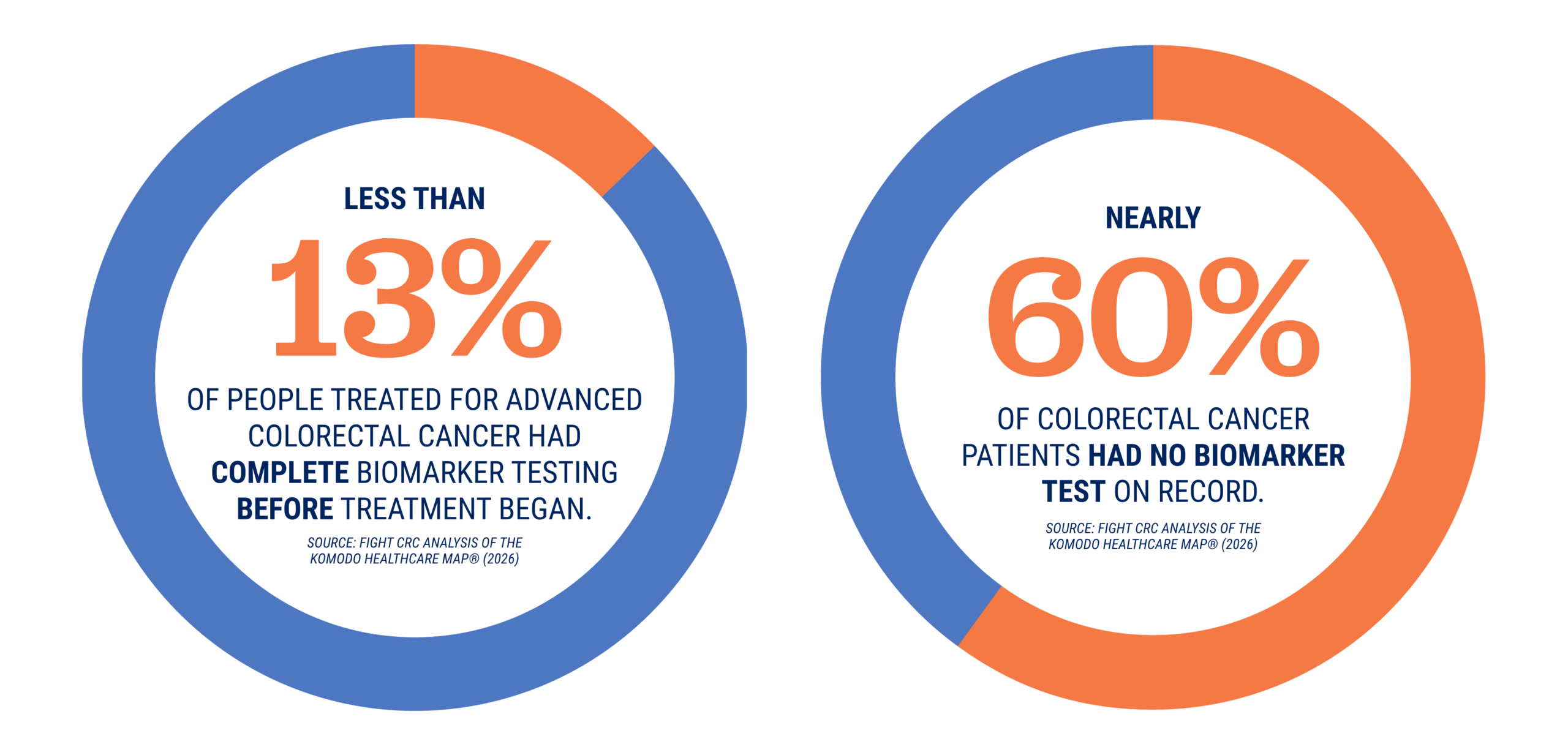
Only about 1 in 8 treated patients with advanced colorectal cancer had complete biomarker testing before starting therapy — the way treatment guidelines require. Nearly 6 in 10 treated patients have no biomarker test on record at all.
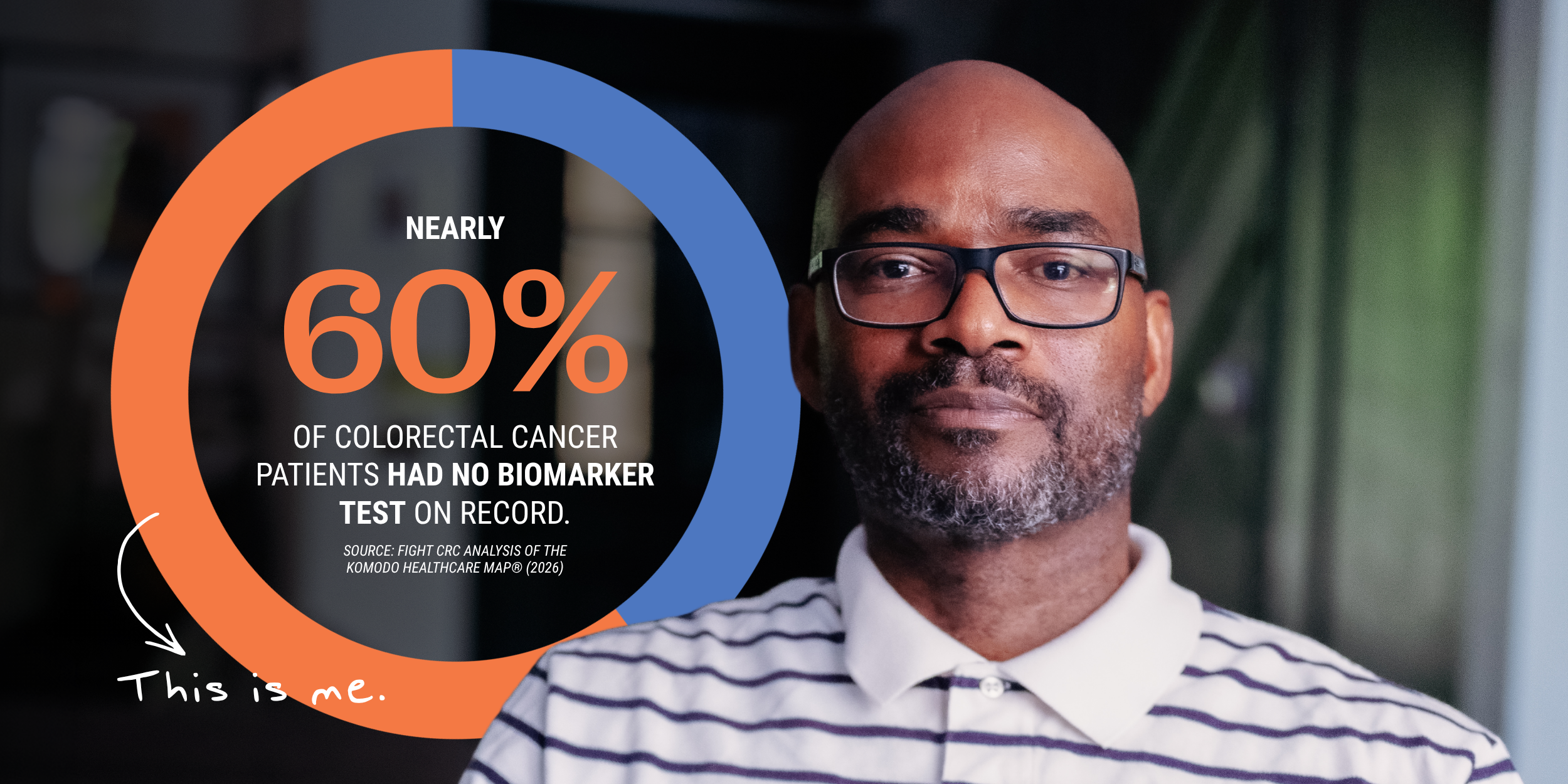

THE GAP ISN’T CLOSING
Across four reportable years — 2021 through 2024 — the share of patients receiving any biomarker testing has not improved. This is largely an access problem, not a technology problem. The tests exist. Getting them to patients before treatment begins is the challenge.
OUR GOAL: 80%
Fight CRC is calling for a national floor of 80% of patients diagnosed with stage 3 or stage 4 colorectal cancer to receive biomarker testing. Today’s guideline-concordant rate is about 1 in 8. Closing this gap is how we give patients more time.
Source: Fight Colorectal Cancer analysis of the Komodo Healthcare Map®; advanced CRC patients ages 18–64. All testing rates are lower-bound estimates from claims data. Learn more in the Colorectal Cancer Care Report →
The Biomarkers
WHAT DO YOUR BIOMARKERS MEAN?
Some biomarkers tell what kind of cancer you have (diagnostic). Some are used to learn about the estimated course of cancer if it goes without treatment by determining cell functioning (prognostic biomarkers), or if your tumor will respond well or poorly to certain treatments (predictive biomarkers).
Biomarkers can give insights to dosing decisions (pharmacodynamic), and they can also indicate if cancer is in your body once treatment ends (recurrence).
Here are the most common and studied biomarkers in colorectal cancer patients that may impact your treatment plan.
Treatment Decision Markers
Help determine which therapies may or may not work
Treatment Decision Markers
Help determine which therapies may or may not work
Treatment Decision Markers
Help determine which therapies may or may not work
KRAS
most common
NRAS
most common
BRAF
most common
HER2
most common
EGFR
most common
Immunotherapy Markers
Show whether immunotherapy may be effective
Immunotherapy Markers
Show whether immunotherapy may be effective
Immunotherapy Markers
Show whether immunotherapy may be effective
MSI-H / dMMR
most common
PD-L1 Pathway
Tumor Mutational Burden (TMB)
Monitoring & Recurrence
Track cancer activity and detect recurrence
Monitoring & Recurrence
Track cancer activity and detect recurrence
Monitoring & Recurrence
Track cancer activity and detect recurrence
CEA
most common
ctDNA
most common
CTC
Rare / Targetable Alterations
Less common markers that may open targeted treatment options
Rare / Targetable Alterations
Less common markers that may open targeted treatment options
Rare / Targetable Alterations
Less common markers that may open targeted treatment options
TRK Fusions (NTRK)
RET
Tumor Biology & Characteristics
Provide insight into how the cancer behaves
Tumor Biology & Characteristics
Provide insight into how the cancer behaves
Tumor Biology & Characteristics
Provide insight into how the cancer behaves
Sidedness
most common
WNT Pathway
Treatment Safety & Dosing
Help avoid harmful side effects from certain treatments
Treatment Safety & Dosing
Help avoid harmful side effects from certain treatments
Treatment Safety & Dosing
Help avoid harmful side effects from certain treatments
DPD

Biomarker Report Types
Several kinds of tests can be run on your tumor and/or blood. You and your doctor should choose based on your specific situation.
single biomarker
Multigene panel
Whole-exome
Whole-genome (NGS)
Mutational burden
Biopsy types
Several kinds of tests can be run on your tumor and/or blood. You and your doctor should choose based on your specific situation.
Tumor biopsy
Liquid biopsy
Cost & Coverage
What to do if your testing is denied
A denial is not the end of the conversation. Many are overturned on appeal — often because the first submission was missing a guideline citation or had a coding error.
- Get the denial in writing
Ask your insurer for the written denial and the specific reason code. You cannot appeal what you can’t see, and the reason is often a coding or paperwork error rather than a coverage decision. - File the internal appeal on time
Every plan has a deadline — often 180 days from the denial. Submit the letter, your pathology report, and the guideline citation together, and keep a copy of everything you send. - Ask your doctor for a letter of medical necessity
The letter should state your diagnosis and stage and cite the NCCN Clinical Practice Guidelines that recommend the test for your situation. This is the single most effective piece of an appeal.Which biomarkers were tested, and can I have a copy of the report? - Request an external review
If the internal appeal fails, you can request an independent external review by a reviewer who does not work for your insurer. Your denial letter must tell you how. - Ask about self-pay and assistance in parallel
While the appeal is open, ask the lab what the self-pay price is and whether you qualify for their assistance program. Many patients pay far less than the billed amount. - Get a person on your side
A hospital social worker, financial navigator, or a Patient Advocate Foundation case manager does this every day and can take the calls with you or for you.
Videos & Webinars
Webinars and short explainers with the oncologists, genetic counselors, and patients who live this every day.

Colorectal Cancer Biomarker Testing: Ask Before Treatment Starts
video
Ron, Lyle and Sydney were each diagnosed with colorectal cancer. Their stories show why one question matters before treatment begins: has my tumor been tested for biomarkers? A new analysis of de-identified, real-world data from Komodo Health’s Healthcare Map® finds that only about 1 in 8 treated patients ages 18 to 64 had complete testing before treatment. Source: Komodo Health. Komodo Healthcare Map: de-identified, real-world patient data representing more than 330 million de-identified U.S. patients. Data accessed October 2026.

What are biomarkers, and how can they help?
video
Doctors and scientists from around the world spend two days deciding what to study next about colorectal cancer in people under 50 — in the same building as our advocates, so what they learn goes straight to Congress.
Keep learning on our youtube channel
The full library has webinar replays, patient stories, and short explainers covering biomarkers, treatment decisions, and the questions worth bringing to your care team.
FAQs
Grouped by what you’re trying to figure out. The first question in each group is open — expand the rest as you need them.
I’ve seen the terms “somatic testing” and “germline testing.” What’s the difference and what does it have to do with biomarkers?
What if my doctor doesn’t recommend a biomarker test I know I need. (For example, if I have metastatic disease and I know I need HER2 evaluated).
What will my results look like? Will I get to see them?
Is it possible to have both KRAS and BRAF mutations?
Why do I need biomarker testing before I start treatment?
What if I’ve received treatment already and I don’t know my biomarkers?
Will I need another biopsy to test my tumor?
Why haven’t I heard about this before?
What are the downsides of biomarker testing?
I’ve had genetic testing. Does this mean I’ve had biomarker testing?
I’ve been told I have Lynch syndrome. Does this mean I’ve had biomarker testing?
Will my insurance cover biomarker testing?
Is there financial assistance for biomarker testing?
Who makes the guidelines about biomarker testing?
As of 2022, the National Comprehensive Cancer Network (NCCN) recommends microsatellite stability/instability (MSS/MSI) biomarker testing for all CRC patients, regardless of stage at diagnosis. Furthermore, they recommend KRAS, NRAS, BRAF, and HER2 biomarker testing for patients with stage IV, metastatic CRC.
There are several biomarkers without standardized recommendations. As research continues to evolve, guidelines and recommendations will also likely change to reflect the most relevant and meaningful research.
What if I need help facilitating my biomarker testing?
How do I have a conversation about biomarkers with my physician?
How often should I get biomarkers testing?
Last reviewed November 11, 2026 by the FightCRC Team
Content on this page follows the NCCN Clinical Practice Guidelines in Oncology and is reviewed annually by a member of our Medical Advisory Board. It is for education only and is not a substitute for advice from your own care team.
We are fighting for you
We've set goals to improve care for every patient
Fight CRC has set measurable national goals for the care patients receive — for you and for every family, no matter where they live. Here’s what’s happening right now, and what we’re holding the system to.
Our goal: 80% of patients diagnosed with CRC receive biomarker testing in accordance with NCCN Clinical Practice Guidelines.
CRCCI Target 2.1
See What's Happening
80% of patients tested per NCCN guidelines — the CRCCI target
1 in 8 Only about 1 in 8 treated patients with advanced colorectal cancer had complete biomarker testing before starting therapy — the way guidelines require. The standard is effectively 100%.
60% Nearly 6 in 10 treated patients have no biomarker test on record at all.
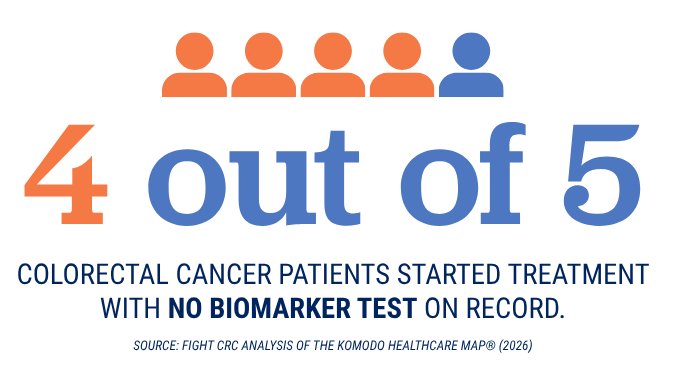
4 in 5 About 4 in 5 treated patients started treatment without complete biomarker results in hand.
Genetic and biomarker testing is not routinely performed. Closing the gap between 30% and 80% means more patients matched to targeted therapy — and more time with the people they love.
Get free patient resources in your inbox
Not all colorectal cancers are the same. Biomarker testing tells you and your doctor what is actually inside your tumor — and which treatments are most likely to work for you.
- The biomarker brochure and conversation guide, free
- New webinars and patient stories as they publish
- Unsubscribe any time — we never sell your information
By signing up you agree to receive email from Fight Colorectal Cancer. We never sell or share your information.