


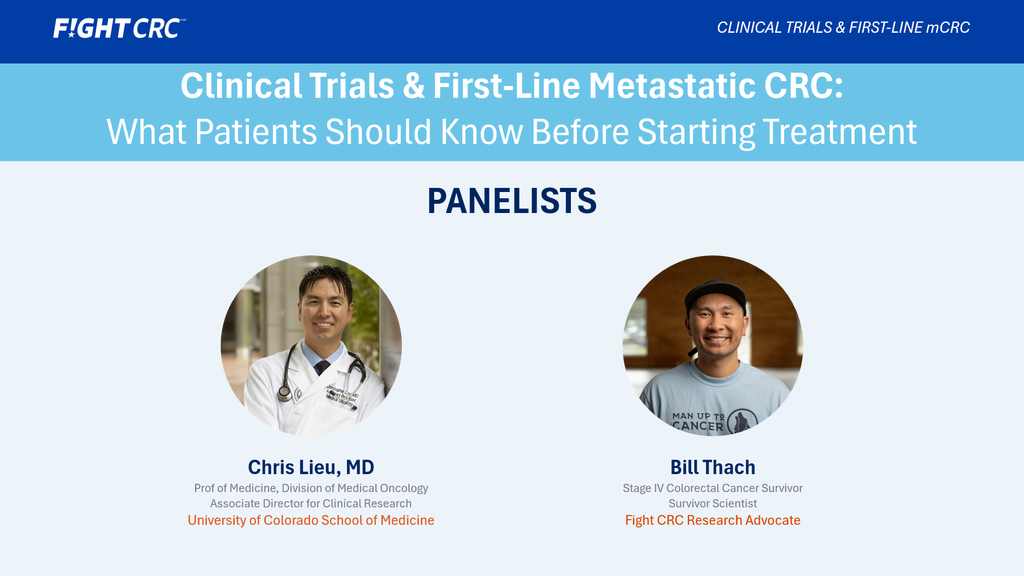
Frequently Asked Questions from the Fight CRC Webinar
Starting treatment for metastatic colorectal cancer raises a lot of questions — about biomarkers, treatment choices, and whether clinical trials are right for you. This FAQ captures key takeaways from Fight CRC’s webinar with answers from our expert panelists.
Featuring:
- Dr. Christopher Lieu, Professor of Medicine and Associate Director for Clinical Research, University of Colorado School of Medicine
- Bill Thach, Fight CRC Research Advocate and colorectal cancer patient
What is first-line treatment for metastatic colorectal cancer?
First-line treatment is the first treatment you receive after a metastatic diagnosis. What your care team recommends will depend on your overall health, your tumor’s biomarker profile, your goals, and whether surgery might be an option.
One of the most important early conversations to have with your oncologist: What is the goal of treatment? Is the aim to shrink the cancer? To keep it stable? Getting aligned on that shapes everything that follows.
What questions should I ask at my first oncology appointment?
Dr. Lieu recommends starting with these five:
- What stage is my cancer?
- What treatments are available for me?
- What are the goals of those treatments?
- Has my tumor been tested for biomarkers?
- Are clinical trials available for my cancer?
What is biomarker testing, and does it matter if I already started treatment?
Biomarker testing looks for specific changes in your tumor’s genes that tell your care team how your cancer behaves and which treatments are more likely to work for you. It goes by several names: tumor testing, molecular testing, mutation testing, or next-generation sequencing (NGS).
If you are not sure whether you have been tested, ask now. If you are being treated in the metastatic setting, it is absolutely worth bringing up. Dr. Lieu recommends two direct questions:
- Has my tumor been tested for biomarkers?
- If no, why not? If yes, how do those results impact my treatment now and in the future?
What is the difference between biomarker testing and genetic testing?
They are often confused, but they are different. Biomarker testing looks at mutations within your cancer cells specifically — changes that happened in the tumor, not ones you were born with. Genetic testing looks at inherited DNA and can reveal hereditary risk factors like Lynch syndrome, which has implications for family members as well. Both can be important. Ask your care team whether you have had each.
Should I be thinking about clinical trials from the start?
Yes. Clinical trials are not a last resort — they are a legitimate treatment option at every stage, including first-line. Dr. Lieu’s recommendation: ask your oncologist at your first appointment whether any trials are available for your specific biomarker profile.
If you are told to start chemotherapy first, ask two follow-up questions before you begin: Are there any first-line trials available for me right now? And would one cycle of treatment disqualify me? Many trials allow one prior cycle, so starting standard therapy does not always close the door — but it is important to ask before, not after.
I don’t qualify for the trial I found. What now?
Do not stop there. Ask whether other trials exist, look beyond your current institution, and consider reaching out directly to the trial’s contact on ClinicalTrials.gov. As Bill puts it: “There is always a trial. You just have to do some work to get there.”
Two tools that can help: ClinicalTrials.gov is the full database of open trials. ChatCRC (chatbot.fightcolorectalcancer.org) is Fight CRC’s AI-powered tool that lets you search in plain language — Dr. Lieu demonstrated that a simple prompt surfaced six relevant trials versus roughly 50 unfiltered results on ClinicalTrials.gov.
What is it actually like to be on a clinical trial?
The time commitment is one of the biggest things patients underestimate, especially in early cycles. But Bill also noted that the level of monitoring on a trial is often more intensive than standard care — your health is top of mind for that institution.
Before enrolling, Bill recommends asking: What is the patient’s responsibility? What are the side effect profiles? And what does the time commitment actually look like week to week?
What is the single most important piece of advice for a newly diagnosed patient?
We asked both panelists.
Bill: “Understand that you should be accountable for your own health. Once you do that, you will have the curiosity to find what options are out there for you.”
Dr. Lieu: “Advocate for yourself, but bring people who will advocate for you — a friend, a family member, a patient advocate — because having backup in that room makes a real difference.”
Fight CRC Resources and Next Steps
Learn
Find Trials
Connect
Advocate
Stay Informed
Thank you to Our Sponsor
This webinar was supported by Pfizer. Fight CRC independently develops and curates all content. The information in this FAQ is for general educational purposes only and is not a substitute for professional medical advice. Please consult your care team about your individual situation.

