The Cleveland Cavaliers will host their annual Colorectal Cancer Awareness Night at Rocket Mortgage FieldHouse on March 2, 2022 during a game against the Charlotte Hornets. In partnership with Fight Colorectal Cancer (Fight CRC) and Cleveland Clinic, the evening aims to bring awareness and support to the fight against colorectal cancer.

Throughout the night fans will learn more about colorectal cancer screening and prevention.

  • Rocket Mortgage FieldHouse’s massive exterior curtain wall will be lit blue, the color that signifies colorectal cancer awareness.
  • Fight CRC and Cleveland Clinic will both have information tables throughout the Street Level Concourse.
  • Fans can show their support with blue face paint, tattoos, and custom posters by visiting face decorating and sign-making stations on the concourse.
  • A portion of proceeds from the in-game 50/50 raffle will benefit Fight CRC.
  • Valuable information about the cause will be shared with fans during the game through special videos and announcements, as well as interviews with representatives from Fight CRC taking place in-arena and on Bally Sports Ohio.

On Feb. 2, 2022, President Joe Biden relaunched the cancer moonshot initiative highlighting new goals: “to reduce the death rate from cancer by at least 50 percent over the next 25 years and improve the experience of people and their families living with and surviving cancer—and, by doing these and more, to end cancer as we know it today.”

Fight Colorectal Cancer (Fight CRC) strongly supports President Biden’s call to action to address inequities, utilize personalized medicine, increase progress against the most deadly and rare cancers, support patients, caregivers, and survivors, and learn from all patients.

“We commend the bold vision to fight cancer by President Biden, and we appreciate the vulnerability of Vice President Kamala Harris, who shared that her mother passed away from colorectal cancer,” said Anjee Davis, President of Fight CRC.

The Cancer Moonshot revamp continues the White House’s investment in cancer research. The program will include cancer screening efforts, treatment, and increasing patients’ quality of life after cancer. The need for colorectal cancer screening after COVID-19 delays is great.

To address screening, President Anjee Davis, along with Fight CRC Board Member Dr. Fola May, took part in the President’s Cancer Panel that released a report on closing the gaps in colorectal cancer (CRC) screening just following the Moonshot announcement. The panel’s report focused on connecting people, communities, and systems to improve equity and access to CRC screening. The group identified four critical goals and related recommendations to ensure the benefits of cancer screening reach all populations.

Fighting cancer is personal to this administration and Fight CRC. President Biden launched the Cancer Moonshot initiative in 2016 as vice president under President Barack Obama, not long after his son Beau died of brain cancer.“Let there be no doubt. Now that I am president, this is a presidential White House priority — period,” President Biden said during his remarks at the White House.

Although CRC is preventable with timely screening and very treatable and beatable if caught early, CRC is currently the No. 2 cancer killer. Young cases are also on the rise, and it’s projected that colorectal cancer will be the leading cause of cancer deaths among those ages 20-49 in the next eight years if something doesn’t change.

On March 16-17, Fight CRC—alongside partners and advocates—will be asking members of Congress for more research funding to find new and better treatment options for colorectal cancer patients. Over 27,000 blue flags will be put in the ground on the National Mall to represent people under the age of 50 estimated to be diagnosed with colorectal cancer in 2030. This is the first-ever flag installation hosted by Fight CRC, representing the lives that could be saved by 2030.

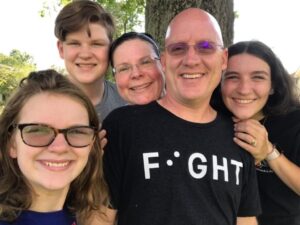
maschke-family-why-call-on-congressMy husband, Joe, was diagnosed with stage IIIb early-age onset colorectal cancer when he was 47. Joe is now 51, and he has been cancer free (big exhale!) since July 1, 2019, which is a tremendous relief. However, thoughts of cancer never end. We still have incredible stress whenever he undergoes scans (“scanxiety“), blood work, and check-ins with his doctors. Colorectal cancer is never a “thing of the past.” It is always lurking in your mind and in the minds of your family members.

I don’t think most people think about colorectal cancer until you or someone you love is diagnosed with it. Then it turns your world upside down. Even after you or your loved one is told they are cancer free, the trauma, and effects of treatment and surgery linger for a lifetime.

There are a growing number of people like my husband being diagnosed at a young age. By 2030, colorectal cancer is projected to become the leading cause of cancer deaths for those ages 20-49. Yet, it’s the cancer no one wants to talk about.

After Joe was diagnosed, my son, then age 13, confided in a friend that Joe had rectal cancer. The then-friend later said in a loud voice in a crowded hallway at school, “Your dad has butt cancer?!” My son was mortified and never spoke to anyone his age about Joe’s cancer again.

Well, let me tell you: I’m going to talk about it.

When I first started working for Fight Colorectal Cancer, I didn’t consider myself an advocate. I’m not a political person, so I didn’t think I would know how to talk with members of Congress. But as we prepare for our 16th Call-on Congress (ConC) March 16-17, 2022, I’ve realized that my voice and my story are critical in the fight for more funding, more research, and more treatment options.

Call-on Congress is an opportunity for advocates from across the country to share your stories and educate members of Congress on issues impacting you and the colorectal cancer community.

This year Call-on Congress will be a hybrid event – meaning we will have opportunities to participate both in-person and virtually. If you join us in person, you’ll be able to attend events around United in Blue, the first-ever flag installation on the National Mall to spotlight colorectal cancer as a national priority and raise awareness that we need to fight for more.

And whether you join us in person or from home, you’ll be able to attend meetings with your members of Congress virtually.

Now, you may be thinking, “Why should I attend Call-on Congress this year? Is it still worth it if we can’t meet with members of Congress in person?“

The answer is “Yes!” Colorectal cancer is vastly underfunded by the federal government, and it is not prioritized by federal agencies as many other cancers are. This needs to change. We are seeing an increase in colorectal cancer in young people, but we aren’t seeing the game-changing advances in research that could help patients of all ages.

If patients, caregivers, and everyone impacted by colorectal cancer don’t fight for more and tell Congress how colorectal cancer has changed our lives, no one else is going to do it for us.

Meeting with members of Congress virtually means it is even easier to share your story. You can do it from home, from work, even from the chemo chair!

Kiel Colon Cancer Foundation, a friend and nonprofit partner of Fight Colorectal Cancer (Fight CRC), is closing its doors after seven years of service to the colorectal cancer (CRC) community. The foundation has asked Fight CRC to carry on its work by running out the #BlueKnots social media campaign and educating and resourcing the Black community about colorectal cancer.

“Fight CRC is honored to continue the Kiels’ mission by working alongside their community of supporters to decrease the number of preventable deaths caused by colon cancer through education and awareness initiatives, encouraging healthy lifestyle choices, and supporting colon cancer research.” – Fight CRC President Anjee Davis

Kiel Colon Cancer Foundation President LaTashia Kiel and her husband, CEO George Kiel, founded the organization in honor of George’s mother, Debra Kiel, who passed away from colon cancer in 2014 at age 57. When Debra was first diagnosed, the family noticed that, at the time, none of the CRC organizations reached their community. The family founded the Kiel Colon Cancer Foundation and hosted fun and physically active events to teach about CRC, placing a special emphasis on colorectal cancer rates in the African American community.

According to the American Cancer Society, Black Americans are about 20% more likely to get CRC, and about 40% more likely to die from it compared to other racial groups.

“This organization has allowed me to honor my mother-in-law’s legacy. The community has inspired me over the years. I have learned so much about the cancer experience in our nation by listening to the stories of patients, families, and their friends.” – LaTashia Kiel, Kiel Colon Cancer Foundation President


LaTashia, a Fight CRC advocate who has shared her story at Call-on Congress, is stepping down from the Foundation to pursue her family nurse practitioner certification and open a clinic that specifically addresses the primary care needs of cancer patients. She’s also working on a research project addressing scanxiety, a huge issue cancer patients face throughout and beyond their treatment. She hopes to shed light on this issue within the medical community and find meaningful, science-based treatment methods. To focus on her new goals, she and George have decided to close the Foundation, but they’ve asked Fight CRC to carry on their initiatives.

Fight CRC will start managing #BlueKnots, a social media initiative that honors those affected by colon cancer and brings worldwide attention to the disease. Participants can engage in the campaign by getting blue shoelaces and tying them into “blue knots,” and posting a photo of them on social media with the hashtag #BlueKnots. Blue shoelaces are available in the Fight CRC store. Fight CRC will also be posting educational content from the Kiels’ website to fightcrc.org to carry on the mission of education.

“We are incredibly grateful for the support and partnership we have had with Kiel Colon Cancer Foundation, and we are honored that they chose Fight CRC to carry on their work. We are looking forward to continuing to work alongside members of their community to raise awareness and provide education and resources.” – Fight CRC President Anjee Davis

It’s hard being a teenager facing cancer, whether you’re the patient or you have a parent who is facing a cancer diagnosis. The teenagers in our community are using their voices to share their stories, in hopes others hear them and know that they are not alone.

Meet the Teens

Elizabeth, Joey, and Caroline Maschke: Elizabeth was 15; Joey was 13; and Caroline was 11 when their dad was diagnosed at age 47 with stage IIIb rectal cancer. Their dad, a full-time firefighter, and part-time ironworker was otherwise healthy and in excellent shape. The GI doctor found their dad’s tumor during a colonoscopy, which he had after showing signs and symptoms.

Erin Verscheure On Aug. 31, 2016, at 18 years old, Erin was diagnosed with stage IV colorectal cancer. She had just graduated high school and was thrown into the real world quickly. Her life before cancer included spending time with family and friends, working, starting college, and being a regular 18-year-old girl. She did not know that colorectal cancer was a reality, so she never even thought about researching it. Suddenly, she was diagnosed with a disease she knows nothing about.

Ryan Shadle Ryan was just 19 years old when his dad Paul was diagnosed with stage IV colorectal cancer in 2016 at age 44. Ryan, unfortunately, lost his dad to cancer in February 2021. Ryan is determined to continue his dad’s mission and advocate on his behalf as a 2022 Fight Colorectal Cancer ambassador.

Chris Ganser Jr. Chris Jr. was just 12 years old when his dad was diagnosed with stage III colon cancer at 34. Unfortunately, his dad passed away in July 2018. Chris’ father was a huge advocate within the Fight Colorectal Cancer community and was one of the four founders of Climb for a Cure, which Chris Jr. now participates in every year in honor of his dad.

Bo McDonald Bo was just 13 years old when he received his colon cancer diagnosis. Bo had surgery to remove a cancerous mass, which was successful. After recovering from surgery, Bo had nine-months of chemotherapy to tackle the cancer that spread to his lymph nodes. Bo has not received chemotherapy for the past three years and says he is living life to the fullest.

Moderated by Danielle Ripley-Burgess, Fight CRC VP of Disease Awareness, and a teen survivor herself. Danielle was diagnosed when she was just 17 years old and is now a three-time, 20+ year survivor.

Where were you and how did you find out you had colon cancer?

Erin: I was on my couch, I had just gotten home from my first college class. When I found out I had cancer I was extremely scared and cried for hours. My mom was my support system and helped me work through it and take it step by step. Everything was new and crazy. My doctor would always say that I am one in a million that I was diagnosed and still here. And I loved that.

Bo: I was in the emergency room. I went to go get a CT scan, and they saw something on the scan. They ran another test that saw a tumor. So, that is how I was diagnosed. At the moment, I remember seeing commercials about going to get screened for colon cancer, I’m like, “OK, that’s normal.” And then, when they said that is what I had, I was just surprised. I did not know what was going on.

How have your friends been throughout your diagnosis? Advice for friends?

Bo: So, I think I had some pretty good friends because I think they actually cared about me. They hosted a fundraiser for me to have money to go through chemo. They had a big piece of paper that they had everyone in the school sign, which they gave to me along with some brackets, which made me feel loved.

Erin: I got diagnosed after graduation, so a lot of my friends were away at school. But, one of my close friends was home. She obviously did not understand what was happening, but she was the best. She did so many things with me. She would stay at my house for days. We would watch movies; she took me to a concert once; and more. She did everything she could to make me feel normal even with everything going on.

How did you cope with having a parent with cancer?

Joey: I played a lot of Xbox and baseball; I still do. So, that was one of the ways. I didn’t necessarily turn to my friends. I was in an age group that really didn’t understand what I was going through. It’s not necessarily that they didn’t have the maturity, but they just didn’t understand. So, I kind of kept my emotions in, but I cried a lot. I think everybody does.

Caroline: I started playing volleyball. The year my dad was diagnosed was my first year ever playing. I played all the time. When I was sad, I would go out front and just hit the ball to get my anger out. I didn’t really talk to my friends about it. A lot of my friends didn’t even know because I was too young and too sad that if I brought it up, I would cry.

Chris: At first, for me, your friends don’t quite understand. I will say that I was able to turn to my dad. He was always very open about his diagnosis and encouraged me to ask him questions. He would also always make jokes. When he got his ileostomy, and people would say they are going to the bathroom, he would tell them he is peeing right now. He would let others know that this does not have to be a heavy subject. But, I would also get my anger out through gymnastics.

Elizabeth: I took a woodshop class, and the teacher and I got along really well. So, I was able to just talk to him about everything and anything that was going on. He made me feel safe. I could tell him anything. I didn’t have a lot of friends in high school. So, I talked to him while I was able to do woodwork, which helped get my anger out. It’s cheaper than therapy, and you get to physically do stuff, which is fun. Another thing I did was write about it because that helped me get it out on paper. It’s like it’s not as bad as it is. “Here are the facts. This is the only thing you know, right now.” My English teacher also helped me through a lot. She shared a quote with me that has gotten me through, not only my dad’s cancer diagnosis, but pretty much everything in life since then.

“It is what it is. But, it will be what you make it.”  – Pat Summitt

My English teacher also helped me write my college essay. In my essay, I wrote about my dad’s diagnosis; what that was like; and how it was the first time I had ever seen him cry, which was really weird. That is how I knew something was really wrong with my dad. When he was diagnosed, he couldn’t even come into the house. My mom came in, and my siblings and I were all holding signs that said, “welcome home.” We hoped everything went well because every time somebody had a test or medical procedure, it did go well, and we didn’t think, “Oh he has cancer.” They came into the garage, and we saw on their faces that it was not good news.

Ryan: I was 19 when my father was diagnosed. So, I was able to rely on my friends during that time. I had a couple of really close friends that I was able to talk to about it. My dad just did a good job of making the situation not as heavy as a subject, as you might think it would be. He was a person I could talk to about anything. In a weird way cancer almost opened up our relationship to help us connect and get even closer. I was able to find ways to talk about it and navigate the conversations, which helped me from my perspective to make things easier.

What does staying involved in Fight CRC in honor of your dads mean to you? How do you find the strength?

Ryan: From my perspective, it was just seeing how much my dad was involved with Fight CRC. I always remember talking to him about what he was doing with his time as an ambassador. And screening was a huge topic that he would always say how much he cared about. Seeing how much passion he had, and how much it helped him when he was diagnosed, was the reason I would like to help carry that on. I want to continue to advocate for those who are getting this disease earlier. How do we catch it? We have to screen and continue trying to raise awareness around that. My dad’s ability to make light of the situation and continue to raise educational awareness is why I wanted to continue to do that. I think he did that up until the day that he passed. He always tried to do what he could to help.

Chris: I think my dad would have absolutely continued to be a part of Fight CRC if he were still alive. And I think that me being a part of Fight CRC is a way to do it for him. I not only advocate for him, but for everyone else.

What are your thoughts on camps for kids whose parents have cancer? And what is the value of going to something like that?

Caroline: I went to a camp for kids whose parents have cancer, and did not want to go because it was only four months after my dad was diagnosed, so it was still a very touchy subject. But the camp wasn’t really as much about talking about it and more just forgetting about it and doing fun things to take your mind off of your parent’s diagnosis. And they did have a coping session that was actually really helpful. It was also nice because you got to meet kids who are in the same league. I met one of my really good friends there, who actually went to the same school as me; we just had never met before. She and I still talk. And it was nice to have someone who understood the exact same thing I was going through and to lean on.

Elizabeth: I wanted to go more than my siblings did. Because I was really excited to talk with people who are in my shoes and are not in the same house. We did so many activities and for one day we were just able to forget about cancer and enjoy the company of other kids who knew the one thing we had in common was that we all had a family member with cancer. But being able to talk about it, learn how to cope with it, and just have fun together to get our minds off of cancer was amazing.

Joey: It really provided us with the realization that there are going to be days where you forget about it, that there is still fun in the world and purpose other than knowing your parent has cancer. I would recommend it.

Survivors have you found any groups that have been helpful?

Erin: I am a part of the Colon Club. When I was diagnosed at 18, I found the Colon Club. I always wanted to be a part of it. I applied and applied; this year, I was accepted. This summer doing the photoshoot really really helped me. When I was 18, I didn’t know anyone with colon cancer, and I was so upset about that; I felt like no one understood. I found a group of people, finally, that get it. I can talk to them about it and have great conversations. We are all still connected. So, definitely the Colon Club has helped me. I really love it.

Bo: I have a camp that I go to, where kids diagnosed with all different types of cancer attend. I met my best friend there. There are a lot of people there that may not know exactly what I am going through but can relate to what’s going on.

Did anybody uniquely step in to help you? What did they do that was so powerful in your life?

Bo: I think it would be my best friend. I would check in with him, but if I was distant from him he would send me encouraging texts.

Joey: I would say both of my parents because they would comfort me and really let me know that it is OK to let my emotions out, crying or feeling anger, really anything that I was feeling. I could feel safe and let it all out with them.

Erin: I would say my grandma who I call, “Nana.” She really stepped up; she took me to every chemo. It was something that we took on together every other week. Her husband died from cancer years ago, so she was in a really bad place, and shortly after that, I was born. So she calls me her “angel.” There is no one else I would want to go through that with than her.

Elizabeth: My parents were really supportive. They are our rocks and just wonderful. They always listen. Even though my dad was the one going through it all, he would still listen. My mom helped us with everything. So, I’m very thankful for them.

What are some stupid things people have said to us? About cancer or about colorectal cancer?

Joey: The first and the only person I have told was in seventh grade. I told him, and he said, “Oh, your dad has butt cancer?” I was 13 when that happened, and I never told any of my friends again.

Erin: I went to an event and a woman pulled me aside and told me, “You are going to lose all of your hair, and it’s going to be the worst thing you have ever gone through.” And a lot of people would ask if I was going to lose my hair or go bald. Also when people first found out I had cancer they would say, “Oh, it’s because you are not eating right.” Or “it’s because you are eating this.” Or “you have colon cancer because your diet is really bad.”

Elizabeth: People would ask me if my dad was going to go bald, but I would always tell them that my dad has been bald my whole life, so that was not something that I worried about.

Bo: I didn’t receive mean comments from people about having colon cancer. But they would just say unnecessary comments like, “That’s exactly why you have cancer.”

Caroline: I remember it was like maybe two weeks after my dad was diagnosed, and he had just gotten in his port, and one of my friends came over for a sleepover, and she didn’t know. And so she saw the port near his shoulder, and she was like, “Oh, did he get shoulder surgery?” And I just said, ”Yeah,” because I was too sad to say, like, “Oh no, he has cancer,” because it was still so new. It was a whole year she thought he had gotten shoulder surgery.

Ryan: When people start to make jokes about colonoscopies. I think that’s a subject that I think people like to joke about, but I think as we kind of learn more about how important they are, I think it becomes less of a good joke. That is something that has always rubbed me the wrong way. But it is also hard to be mad at them because they don’t understand the seriousness of it until they are affected by it themselves. And that’s just one thing I want to do is try to change the stereotypes to go along with it.

Gift ideas for someone who is first diagnosed? Gifts that stood out?

Bo: My Aunt gave me some Hot Wheels cars, and I used to come over to their house, and I was obsessed with them. I remember a time she bought me over 50 Hot Wheels cars, and every time she would see me, she would give me more Hot Wheels cars. Now, I have hundreds of them in my closet. I laugh when I see them and think about how that was the coolest present I could ever get.

Erin: Someone gifted me a journal. When I first got it, I didn’t think I would use it. But it was really good to have a space to write down thoughts, whether it was about cancer or not. It was super helpful.

Chris: My dad’s second big surgery, he had his bladder and prostate removed, so my mom and I got him a stuffed bladder and prostate. And those were pretty good, I would say, if they are up for the joke.

Elizabeth: An ear. And just having someone to talk to, and someone that isn’t just listening; they actually hear what you are saying. Having someone like that is really helpful.

Caroline: Someone gave my dad a blanket that was called, “Cozies 4 Chemo.” My dad was getting chemo during the wintertime, so the blanket kept him warm.

If you could encourage a teenager who is going through what you have been through, what would you say to them?

Erin: I would want them to know that it is OK to let your emotions out. Please feel every emotion. If you cry, you cry. If you’re happy, be happy. Don’t hide your feelings. I always wanted people to know that I am OK even when I wasn’t. Allow yourself to feel everything that cancer is. Because I didn’t allow myself to feel that. If I could go back in time, I would really want to feel the emotions.

Elizabeth: I am going to go back to my quote. “It is what it is. But, it will be what you make it.” I think that will get anybody through anything in life because no matter what the situation is. It’s not that situation that defines you. It’s how you move on from it; how you accept it; and how you move on. And not just move on, but thrive in that situation.

Bo: It’s OK to be upset with what is going on, but cancer does not define you and who you are. It’s the attitude that you take from it, like, “I am going to beat this.” It’s OK to be upset, but don’t let it take over your life.

Caroline: I would say to keep looking forward. We have a sign in our kitchen that my mom made, while my dad was getting treatment. It has a quote from the show, New Amsterdam, “It’s a good news kind of day.” It did turn out to be “good news kind of days.” It was always nice to have that to look to because when we weren’t having good news days, we always knew that brighter days were ahead.

Chris: Take each day as it comes. Don’t overthink about things that are coming up. Just take it day by day. If you just go day by day, then you are going to get through each one.

Ryan: Taking things as they come and trying to make some sort of positive out of it. And I think from my perspective is just:, Take the time that you have with the people around you to make the most of it, and cherish every day because things can change quickly, and it’s always best to live each day to its fullest.

Joey: You gotta find the small things in life that make you happy because there’s really a lot of negative things. But a small thing, though normally wouldn’t mean a lot to you, it can mean a lot to you.

National advocacy organization spearheads initiative that has begun conversations amongst leading scientists, researchers, and advocates who are ready to commit to innovation, push for increased funding, and demand more be done toward finding a cure for colorectal cancer.

Today, Fight Colorectal Cancer (Fight CRC), the nation’s leading patient advocacy organization, revealed its Path to a Cure Report for colorectal cancer (CRC). Path to a Cure is designed to push the science forward for CRC and strengthen advocacy efforts. Out of the initiative has come the Path to a Cure Report, a plan that summarizes and communicates the way forward for the CRC community—a community that has seen very few treatment breakthroughs in the past decade and is anticipating colorectal cancer to become the No. 1 cancer killer amongst 20-49 year olds in the next eight years.

While the rest of the world has been fighting a pandemic, Fight CRC has been developing a plan that ensures patients’ real needs stay at the core part of research efforts. The Path to a Cure Report revolves around pushing forward critical areas of research; care for patients; and policy, from prevention to survivorship.

“As a community, there is tremendous potential when we coordinate our efforts toward common goals. This project brings together many of the thought leaders in the colorectal cancer community who are passionate about accelerating research and improving outcomes for colorectal cancer patients. Together, we can tackle big ideas with ambitious and meaningful impact!” – Dr. Scott Kopetz, research and medical oncologist at MD Anderson Cancer Center

As a catalyst for change, Fight CRC invested two major gifts from former board members Steve Depp and Dina M. Golas. Their legacy gifts enabled Fight CRC to host the first annual Path to a Cure Think Tank in Springfield, Mo. on Dec. 3, 2021. Thought leaders from across the country were convened to discuss what groundbreaking research can be advanced.

Together, working hand in hand across industry, academia, advocacy, public health, government agencies, and with patients, the Path to a Cure Report will drive and unify stakeholders to ask important questions, prioritize, and expand scientific efforts.

“We want to take this plan to Capitol Hill and show members of Congress that this is what we will do with the funds they allocated for colorectal cancer research. We want to show them we developed a plan, we brought together the brightest minds, and here’s why we need the money.” – Molly McDonnell, Director of Advocacy at Fight Colorectal Cancer

Participants in the Path to a Cure Think Tank and Report:

  • Alex Aleshin, MD, MBA – Natera
  • Al Benson, MD – Northwestern University
  • Jordan Berlin, MD – Vanderbilt-Ingram Cancer Center
  • Frank Berger, PhD – University of South Carolina
  • Durado Brooks, MD, MPH – Exact Sciences
  • Timothy Cannon – Inova Medical Group
  • Yin Cao, ScD, MPH – Washington University School of Medicine in St. Louis
  • Andrea Cercek, MD – Memorial Sloan Kettering Cancer Center
  • George Chang, MD, MS, FACS, FASCRS, FSSO – MD Anderson Cancer Center
  • Jeff Crowley – O’Neill Institute for National and Global Health Law
  • Cathy Eng, MD, FACP, FASCO – Vanderbilt-Ingram Cancer Center
  • Dustin Deming, MD – University of Wisconsin Carbone Cancer Center
  • Ryan Fields, MD – Washington University in St. Louis
  • Mark Fleury, PhD – ACS Cancer Action Network
  • Ashley Glode, PharmD – University of Colorado
  • Richard Goldberg, MD – West Virginia University Cancer Institute
  • Samir Gupta, MD – University of California, San Diego
  • Heather Hampel, MS, LGC – Ohio State University Comprehensive Cancer Center
  • Chris Heery, MD – Precision BioSciences
  • Rishi Jain, MD – Fox Chase Cancer Center
  • Wenora Johnson – Survivor Advocate
  • Sheetal Kircher, MD – Northwestern University
  • Jennifer Kolb, MD – VA Greater Los Angeles Health Care System
  • Scott Kopetz, MD* – MD Anderson Cancer Center
  • Smitha Krishnamurthi, MD – Case Comprehensive Cancer Center
  • Kathryn Lang, MBBS, MRCP – Guardant Health
  • Dung Le, MD – Johns Hopkins Medical Center
  • Chris Lieu, MD – University of Colorado Cancer Center
  • Fola May, MD, PhD – University of California, Los Angeles
  • Neal Meropol, MD – Flatiron Health
  • Noel de Miranda, PhD – Leiden University
  • Van Morris, MD – MD Anderson Cancer Center
  • Caitlin Murphy, PhD, MPH – University of Texas Southwestern
  • Heidi Nelson, MD – American College of Surgeons
  • Linda Overholser, MD, MPH – University of Colorado Cancer Center
  • Michael Overman, MD – MD Anderson Cancer Center
  • Swati Patel, MD – University of Colorado
  • José Perea, MD – Fundación Jiménez Díaz University Hospital
  • Curt Pesmen – Survivor Advocate
  • Nicholas Petrelli, MD, FACS – ChristianaCare Health System
  • ​​Lisa Richardson, MD – Centers for Disease Control and Prevention (CDC)
  • Leonard Saltz, MD – Memorial Sloan Kettering Cancer Center
  • Nina Sanford, MD – UT Southwestern
  • Cynthia Sears, MD – Johns Hopkins University
  • Rebecca Seigel, MPH – American Cancer Society
  • Wendy Selig – Meeting Facilitator
  • Robert Smith, PhD – American Cancer Society
  • Peter Stanich, MD – Ohio State University
  • Scott Steele, MD, MBA – Cleveland Clinic
  • Joel E Tepper, MD – University of North Carolina School of Medicine
  • Erin Van Blarigan, ScD – University of California, San Francisco
  • Jennifer Weiss, MD, MS – University of Wisconsin
  • Karen Wheling – Survivor Advocate
  • Ann Zauber, PhD – Memorial Sloan Kettering Cancer Center

Organizations and individuals committed to finding a cure for colorectal cancer are encouraged to become strategic partners of the Path to a Cure Report. Strategic partners’ support will amplify the effort and showcase its importance, especially to policymakers who are making funding decisions.

On a hot summer day, an ice-cold lemonade or popsicle sounds like perfection to many. But if you are on certain chemo regimens and suffering from cold sensitivity, that cold treat can seem like your worst enemy.

Many colorectal cancer patients are treated with a combination of drugs referred to as FOLFOX, which includes oxaliplatin, folinic acid, and fluorouracil. Oxaliplatin, specifically, is notorious for increasing a person’s sensitivity to cold. It causes numbness, tingling, and muscle spasms, which are made worse by exposure to cold temperature and coming into contact with cold objects.

The most striking side effect, however, is due to a short-term nerve damage that occurs in the mouth and throat, making it difficult to eat or drink anything cold in the days after treatment. Additionally, FOLFOX often leads to chemotherapy induced peripheral neuropathy (CIPN). CIPN is a progressive and sometimes irreversible condition of the hands and feet. Patients often describe it as feeling numb, tingling, and painful, and it also leads to a sensitivity to cold.

“When I went through 12 rounds of Folfox, I had bad cold sensitivity when I would swallow anything cold (shards of ice sensation).” – Andrea Deacon, stage IV colon cancer

“Icing” May Help

For decades, patients have lived through these uncomfortable side effects as just par for the course of cancer treatment. However, patients have been spreading the word about the benefits of using ice to help curb cold sensitivity. Though it seems counterintuitive, studies suggest it just might be working.

An April 2019 study published in the Journal of the National Comprehensive Cancer Network showed that gastrointestinal cancer patients who kept ice chips in their mouth during their oxaliplatin infusion (called “icing” by some) developed less cold sensitivity in their mouths compared to patients who did not keep ice in their mouths during treatment. The benefit of this is that those patients could eat and drink with less discomfort.

“Currently I’m on CapOx, 5th round, and I’m icing. Huge difference with the past! Now I can drink cold beverages.” – Andrea Deacon, stage IV colon cancer

COLONTOWN’s Icing Protocol

Through anecdotal experiences, patients in the COLONTOWN “Live Wire” online Facebook group began experimenting with their own icing protocols and reported successful outcomes. The protocol involved icing 10 minutes prior to starting oxaliplatin and applying cold packs to the hands and feet and sucking on or chewing something cold, like ice chips, popsicles, or ice-cold drinks, throughout the infusion and for 2o minutes after the infusion ended. Many members in the group have reported positive results with the protocol.

COLONTOWN’s leadership presented an abstract about the power of patient communities and icing tips at ASCO 2020. According to their conclusions, “this real-world example highlights the role of educated patient advocates on social media. Working with these groups directly can provide insights for the medical community on measures patients can do to prevent chemotherapy-associated side effects.”

“It is exciting to see something so simple as chewing on ice during a FOLFOX infusion make a big impact on a CRC patient’s quality of life during chemotherapy. Before this, we did everything we could to avoid anything cold. Now, some patients leave their infusion center and go get ice cream! I am most excited to see the long-term effects that icing might have on reducing CIPN. This shows the power of patients in an educated social media setting.” – Dr. Dana Cardinas, retired podiatrist, stage IIIc survivor

Chryotherapy is not new

The idea of cooling specific body parts during cancer treatment is not totally new to the cancer landscape. A study from 2017 showed that women with breast cancer receiving chemotherapy with a taxane, anthracycline, or both, who underwent scalp cooling were significantly more likely to have less than 50% hair loss compared with no scalp cooling.

Another study with breast cancer patients used cryotherapy during treatment to affect CIPN. In this study, patients who were treated with a paclitaxel or a paclitaxel-containing regimen wore a frozen sock on one foot and a frozen glove on one hand for an hour and a half, which included the duration of the treatment infusion. The study endpoint assessed the changes in tactile sensitivity from a pretreatment baseline, comparing the hand and foot that were using the frozen glove and sock to the hand and foot that did not. While the study group was small, fewer than 40 people, the study showed that cryotherapy is useful for preventing both the objective and subjective symptoms of CIPN and resultant dysfunction.

More research is needed

More research is needed into the benefits of “icing,” however patients are saying it’s worth a try. To learn more and chat with other patients trying icing, join COLONTOWN’s Live Wire group.

watch our webinar on icing

Meet Toodles. Toodles is the ostomy of Kimberly Holiday-Coleman, stage II colorectal cancer survivor. Kimberly’s introduction to Toodles came after a procedure that saved her life, and she’s been cancer-free now for five years!

“Toodles is fabulous! Toodles is the fabulous reason that I’m still here,” Kimberly says.

Toodles and Kimberly didn’t get off to a great start, however. Kimberly says that she, like many others, wasn’t fully prepared to look down and see an ostomy. When her first ostomy nurse changed it for the first time, it gushed. Kimberly was horrified. But her nurse gave her a tip: Name your ostomy bag. That way, if anything unexpected happens, you have someone to blame. Did your ostomy bag make a fart noise? No problem. Toodles did it

Kimberly and Toodles have come a long way. Kimberly’s now a burlesque dancer who includes Toodles in some of her performances. After shows, she hears from audience members who’ve had ostomies who felt connection and joy in her performance. Kimberly’s positive attitude is proof that anything is possible — even burlesque dancing — with an ostomy.

Kimberly and Toodles are frequent partners in nights out with friends. As the holiday season approaches, she offers advice about how to enjoy a night out with friends at parties when you have a Toodles of your own.

Do you have any words of encouragement for someone who may be going out with an ostomy for the first time?

To get an ostomy, most people have been suffering – maybe with IBD, or Crohn’s or colitis, or like myself, colorectal cancer. For these people, going out hasn’t been a thing for a while. So the fact that you can go out again because of this lifesaving device should put you in the head space of, “I’m winning.” So even if you’re just spending an hour out with your friends, it’s awesome.

How do you prepare for the unexpected when you go out?

I travel with two different bags. I have a travel bag in my car that has four or five changes in it, and it can last me for days, theoretically. I also have a cute little handbag that I can keep in my purse or just in my hand. It’s shiny and cute, and it has about two or three changes. In it, I have a little mirror, two or three bags, extra wipes, different pads, and a little air freshener. So if I’m out and something happens, I can just excuse myself. And no one even knows what’s in there! The bag is just the size of my hand.

Another thing I do to feel comfortable is to tell my friends and family about the ostomy because it reduces my anxiety if something happens. But that’s up to each individual, whether they want to reveal that.

Any tips on eating and drinking?

Everyone’s ostomy is different, but generally, bubbly things can cause gas for us. So while I love to drink champagne, I can’t always do it. But if I do know I’ll want to have some later, I’ll take a Gas-X or something ahead of time that’s been approved by my doctor. I can drink mulled cider and different kinds of wine.

Do test runs before you go out, and try different foods ahead of time. Some foods can cause blockages, like popcorn, nuts, salads, and raw vegetables. Also, when we’re at parties over the holidays, we’re usually chatting all the time. And for us, that’s not great to do while eating because we need to be able to chew a lot to break down our food. So let people know, “Hey, you talk to me while I eat.” That way, you don’t have to talk and take in air, which creates gas, which can create adverse effects.

Be mindful of different foods. I usually go for cooked foods, small foods – foods I can still have fun with and be part of the party.

Should you have any special considerations when choosing an outfit?

Yes! Wear things that make you feel fabulous! Just because we have an ostomy doesn’t mean that we are relegated to sadness. We have this lifesaving device that affords us extra time, and we should be celebrating that! I am all for wearing things that make you feel fabulous.

Sometimes my “fabulous” means that I wear something flowy and beautiful. Other times I go for something form-fitting, and that means I wear tank-tops underneath or high-waisted underwear to help flatten my silhouette.

When heading out for the evening, what should people with an ostomy bring along?

Sometimes I’ll pack an extra pair of underwear in my bag. Sometimes, I’ll bring a change of pants or an extra outfit and keep it in my car – or I’ll “Marie Kondo it” into my bag. Because sometimes things happen, and just knowing that you have that extra set of clothes, even if you don’t need it, you feel more comfortable because you have it.

read Kimberly’s story

Fight Colorectal Cancer (Fight CRC) brought together change-makers from the Catalyst State-By-State Advocacy Program in Springfield, Mo. on December 2, 2021. Members of this program gathered to share best practices for passing legislation, learn from each other’s successes and collaborate on future colorectal cancer (CRC) screening policy priorities.

“When we launched this program, we thought it would mean we were in person a lot; we thought we were going to be in every state, doing action planning, going to state capitals and more,” said Molly McDonnell, Fight CRC’s Director of Advocacy. “COVID-19 had other plans for us, but we never could have imagined that we’d be able to accomplish so much in such a short amount of time, and particularly during such a difficult two years.”

The meeting celebrated the many victories to come from the Catalyst program within its first two years. Additionally, attendees discussed topics like:

  • The current state policy landscape
  • Announcement of the new Catalyst grantees in New York, New Jersey, Indiana, and Virginia.
  • Special messages from CRC survivor Mary Ellen Goodwin, Majority Whip, Rhode Island State Senate, and stage III colon cancer survivor Yla Flores
  • Statewide screening data from Arkansas presented by Craig Wilson, Arkansas Center for Health Improvement (ACHI)
  • Health equity and the importance of building genuine, long-term relationships in underserved communities through advocacy from Candace Henley, MPH, Founder & Chief Surviving Officer, Blue Hat Foundation.
The Fight CRC Catalyst State-by-State Advocacy Program will continue to meet virtually to accelerate progress toward turning aspirational colorectal cancer screening goals into reality by increasing access and reducing barriers to colorectal cancer screening.

The Catalyst State-by-State Advocacy Program is supported by Exact Sciences, Genentech, Bristol Myers Squibb and No-Shave November.

National nonprofit Fight Colorectal Cancer (Fight CRC) and health policy experts at the Arkansas Center for Health Improvement (ACHI) have developed a report assessing the prevalence of colorectal cancer screening in Arkansas and identifying gaps in access to screening. They plan to use the findings to advance policy change to help increase access to life-saving colorectal cancer screening in Arkansas and across the country.

With timely screening, colorectal cancer can be prevented or detected early ― when it’s most curable. Unfortunately, one in three people are not up to date on colorectal cancer screening. For patients at average risk, there are multiple options for colorectal cancer screening, including less invasive tests such as the fecal immunochemical test, or FIT, and Cologuard. These can be great tools to help increase screening rates.

However, if a patient receives a positive result on a non-invasive test, they must get a colonoscopy to complete screening. Unfortunately, the report found that among Arkansas patients ages 50 to 75 enrolled in Medicare, commercial insurance, traditional Medicaid or Arkansas Works, three out of five face financial barriers to accessing that necessary colonoscopy. Using the data report developed by Fight CRC and ACHI, states across the country will be able to leverage data to inform policy change to help remove barriers to colorectal cancer screening.

The report draws on data from the Arkansas All-Payer Claims Database, a part of the Arkansas Healthcare Transparency Initiative. The initiative was created under a 2015 legislative act to bring increased transparency to healthcare utilization, quality and price information in Arkansas. Twenty-one states have created or are implementing all-payer claims databases.

“Data is an incredibly powerful advocacy tool. Fight CRC is thrilled to partner with ACHI on this report that will help empower advocates across the country to leverage their state data and build a case for policy change to help remove barriers to colorectal cancer screening.” – Molly McDonnell, Fight CRC’s advocacy director

Craig Wilson, J.D., M.P.A., the director of health policy at ACHI, presented the report at Fight CRC’s State-by-State Catalyst Meeting in Springfield, Mo., on Dec. 2. Wilson highlighted the importance of sharing data alongside advocate stories to make legislative change.

“At the core of this report we looked at access issues for colorectal cancer screening in Arkansas, but it is now a blueprint for other states to use on their own populations. Our hope is that this blueprint will be shared and used to make real policy change in states across the country.” – Craig Wilson, J.D., M.P.A.

The Arkansas General Assembly and Gov. Asa Hutchinson have recognized the importance of improving access to colorectal cancer screening. On April 21, Hutchinson signed into law Act 779 of 2021, which will lower the age range for covered colorectal cancer preventive screenings from 50 and above to 45 and above, effective Jan. 1, 2022. The new law will also prohibit cost-sharing for a follow-up colonoscopy — a colonoscopy performed after a positive or abnormal result from a non-colonoscopy colorectal cancer screening test, such as a fecal immunochemical test, Cologuard, or a high-sensitivity guaiac fecal occult blood test. The law will apply to most individual and group insurance policies, including those covering Medicaid expansion beneficiaries through the Arkansas Works program and the state and public school employee health benefit plan. This law has also been passed in several other states across the country including Texas, Rhode Island, California, Oregon, Kentucky, Maine, and Illinois.

Fight Colorectal Cancer and the Arkansas Center for Health Improvement Use Data To Advance Policy Change in Arkansas and Beyond

Donate Now